Workholding Tips for Magnetic Chucks

A magnetic chuck holds best when the part is flat, clean and sits across both poles. These tips help with the jobs where that is harder to arrange.

Holding awkward parts

Most hard to hold parts have one problem in common. Only a small area touches the top plate. The aim is to give the magnetism a path into the part.

  • Small parts. Load several parts at once, and pack steel pieces around the sides and ends for support. For thin one off parts, use a fine pole chuck. See how to choose a magnetic chuck.
  • Deep or odd shaped parts. Make a simple jig from mild steel and a non-magnetic material such as brass. The mild steel carries the field up into the part. The non-magnetic layers keep the north and south paths apart. Place the jig so it sits across the poles.
  • Repeat work. Fit an extra top plate to the chuck and shape it to the part. The part then touches a much larger area, and the chuck itself stays unmachined.
  • Tall, thin parts. Stand two steel jaws on the chuck, one on north poles only and one on south poles only. Place the part between them. The field passes from one jaw through the part to the other, and the part is held without distortion.

Milling on a magnetic chuck

Milling puts much larger forces on a part than grinding does. The forces come in blows as each tooth strikes, and their direction keeps changing.

A chuck is best at holding a part down. It resists sliding much less well. So:

  • Always use side stops and end stops. Place them so the cutting force pushes the part against them.
  • Put packing blocks between the stops and the part, so the part stays over both a north and a south pole.
  • Use climb milling (down-cut milling) where the machine is built for it. The cutter pushes the part down onto the chuck, so heavier cuts can be taken.
  • In up-cut milling, the cutter tries to lift the part and push it along. Put the end stop against that push.
  • Build up feeds and cut depths slowly on a new job.
  • Before you start the feed, check the part, stops and packing are in place.

Installing a chuck

A chuck leaves the works ground flat and parallel. It can still be damaged in transport or handling, so check it before fitting.
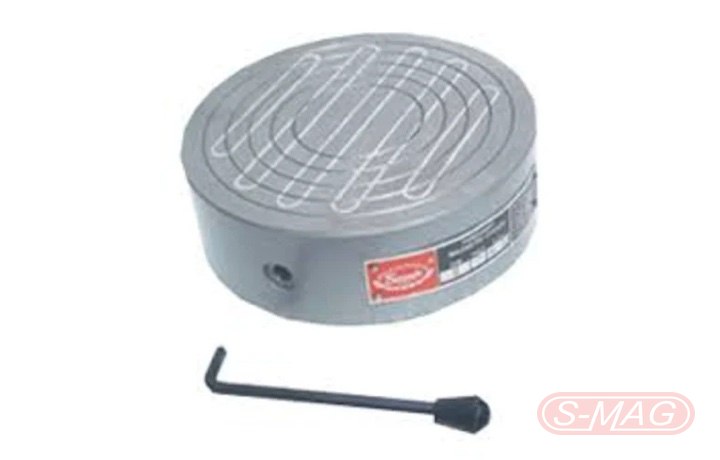
A SMAG circular permanent magnetic chuck.
  1. Check the machine table is clean, undamaged and flat.
  2. Check the chuck base is flat.
  3. Clean the table and the chuck base completely. One grain of dirt between them will tilt the chuck.
  4. Fit the chuck and bolt it down.
  5. On a grinder, grind the top plate on that machine, so it is true to that table.

On a lathe, the chuck needs a back plate. Use screws that stop short of the inside of the chuck. A screw that goes too far can jam the moving magnets.

Regrinding the top plate

Regrind the top plate when it is worn or marked. A thick top plate can be reground many times before it needs replacing.

  • Switch the chuck off while you regrind.
  • Use a medium hard wheel with an open grit.

Mounting a chuck on its side

A rectangular chuck can be mounted on edge, for example on a large angle plate. Keep the edges of the top plate and base plate from touching steel at the same time. That would short circuit the field and weaken the hold. A non-magnetic spacer at least 3 mm thick, in brass or austenitic stainless steel, prevents this.

Drilling and machining a chuck

Simple holes for locating pegs and driving pegs are fine. Follow these rules:

  • Never drill through into the inside of the chuck. Coolant and dirt get in, and a projection can jam the magnets.
  • Keep every hole at least 5 mm shallower than the plate is thick.
  • Drill only in the solid parts of the plate. Keep clear of the pole inserts and the spacers between them.
  • On a laminated fine pole top plate, keep clear of the tie rods. You can see them from the chuck ends.

Grooves or recesses cut for one job can spoil the chuck for the next. An extra top plate is usually the better choice. Contact us before any larger machining.

When a part will not hold

ProblemCheck
Chuck will not switch on or offDamage to the surface or body. Return it for repair if you find any.
Part will not holdIs the part magnetic? Is it thick enough to take the field? Does it sit across at least one north and one south pole?
Part slidesSide and end stops are missing or in the wrong place.
Part holds weaklyAir gaps from dirt, swarf or a rough surface. Clean the chuck and the part.
Part will not hold on a jigThe jig is in the wrong place, or it lets the field bypass the part.

The SMAG range

Santosh Magnetic Works makes rectangular and circular permanent magnetic chucks, with the Rectangular Universal Chuck suited to grinding, turning and light milling. See the workholding range or contact us with your machine and part sizes.