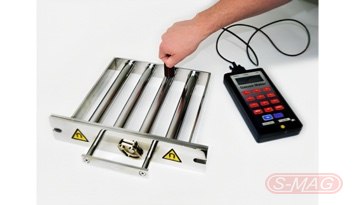
Gauss Meter
Hand-held meter for checking magnet strength
Iron gets into a product line in many ways. It comes in with the raw material. It wears off mills, screws and mixers. It is dropped during maintenance. A magnetic separator pulls this iron out of the product before it damages a machine or reaches a customer.
A magnetic separator is a magnet placed in the path of the product. It holds iron and steel, and the clean product carries on through the process. It works on powders, granules, pellets, flakes, liquids, pastes and slurries.
A separator has no power supply and no moving parts in the magnet. The collected iron stays on the magnet until the operator cleans it off.
The product moves past the magnet. It may fall by gravity, be pumped, be blown through a pipe or be carried on a conveyor. On its way it passes through or over a rod, grid, grate or plate.
The magnetic field pulls iron particles onto the magnet face or the rod surface. They stay there. At each clean, the operator removes the magnet or opens the housing and wipes the iron away.
Separators fall into two groups.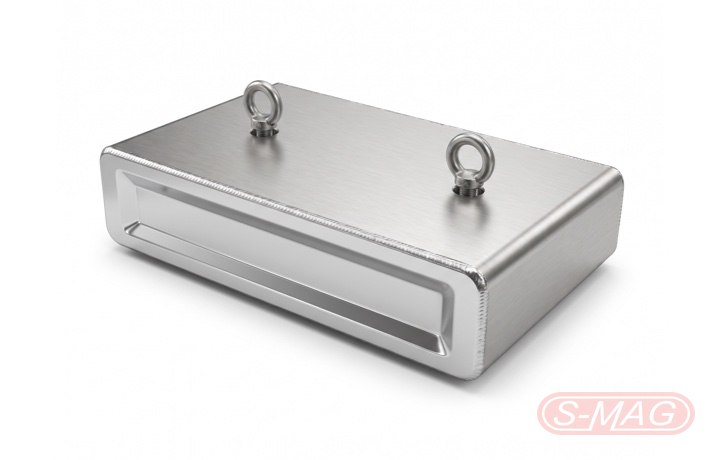
Primary separators remove large tramp iron such as nails, bolts, nuts, wire and tool pieces. Their main job is to protect machines. They sit at intake points and on lines that carry coarse material such as pellets or flakes. Plate magnets are the usual choice here. They sit over a conveyor, in the floor of a chute or on a hinged chute door.
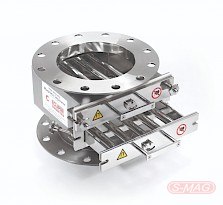
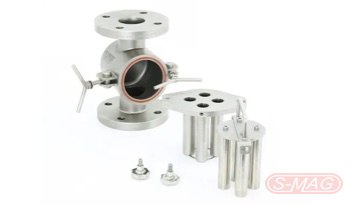
Secondary separators remove fine iron, such as wear particles from process machinery. Their main job is to protect the product. They sit in the middle or at the end of a process. Rods, grids, drawer housings and liquid traps are the usual choice here. A grid in a sealed housing suits a closed gravity line. A liquid trap suits a pumped pipeline.
Many lines use both. A plate magnet at intake takes out the large pieces, which could bridge across the rods of a grid or damage them. A grid or housing further down takes out the fine particles.
Common positions include:
A magnet at intake checks what arrives. A magnet mid-process catches wear from the plant. A magnet before packing protects the finished product. A plant with HACCP control points usually places a separator at each one.
Yes. Neodymium magnets, also called rare earth magnets, are the strongest material. They hold very fine iron particles. They suit food, pharmaceutical, plastics and chemical lines, where fine particles are the main risk. Rare earth rods should stay below 100 degrees Celsius.
Ferrite magnets are weaker. They cost less and project a field further, so they suit coarse tramp iron and deep product beds on conveyors.
SMAG neodymium rods come in four strengths:
| Grade | Surface strength |
|---|---|
| Standard | 7,000 to 8,000 gauss |
| High | up to 9,000 gauss |
| Super high | up to 11,000 gauss |
| Extreme high | up to 13,500 gauss |
Ferrite and Ferrearth rods are made for coarse iron at lower cost.
Strength is given in gauss. A higher figure means a stronger field. In a separator, the magnet sits inside a stainless tube or cover, so the useful figure is the one measured on the outside of that tube or cover. Ask for this figure when you compare separators.
Magnets can weaken over years of use, heat or knocks. A gauss meter reads the surface strength so it can be checked against the original certificate.
Much process equipment is made from 304 or 316 stainless steel. Solid pieces of these grades are only weakly magnetic. Stainless steel that has been worked, cut or worn becomes more magnetic. Fine wear particles of this kind can be held by high strength neodymium rods. The extreme high strength rods are made for this job.
Aluminium, copper and brass are not magnetic. A magnet cannot catch them. Many plants also run a metal detector after the final magnet as a separate check for these metals.
Santosh Magnetic Works makes grids, housed grids, drawer housings, liquid traps, plate magnets, chute magnets and separator rods at its works in Mumbai. Each unit leaves with a tested certificate of magnetic strength. See the separation range or contact us with the product, the flow rate and the space you have.