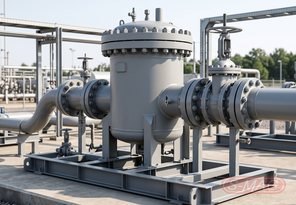
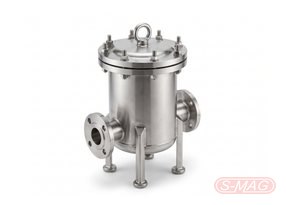
Inline Magnetic Pipeline Filter
Stainless magnetic filter for black powder on smaller lines
Black powder is a common problem in steel pipelines. It forms in gas, oil, petrochemical and aviation fuel lines. It is fine iron sulphide and iron oxide, made by corrosion of the pipe wall. The particles are very small, often less than a micron across. They can travel as a dry powder, stay suspended in a liquid, or settle as a black sludge.
Carbon steel pipe corrodes when certain substances are present in the flow. The main ones are:
Together they attack the inside of the pipe. Iron from the wall reacts to form iron sulphide and iron oxide. These compounds break away from the wall as fine particles and join the flow.
The process is slow. Over months and years, an untreated line can collect a large amount of black powder. The flow also rubs against the pipe wall, and this erosion adds more particles.
It narrows the pipe. Black powder settles along the pipe and at low points. The open bore gets smaller, so flow and pressure fall. Operators then have to scrape or pig the line to clear it.
It wears equipment. The particles are hard and abrasive. They wear the pipe wall and damage compressors, pumps, valves and burner nozzles. They can also block small passages. A meter with black powder in it can give false readings.
It blocks barrier filters. Many lines use cartridge or barrier filters to catch black powder. The fine particles soon block them. Each blocked filter has to be removed, replaced and disposed of. This brings a steady cost in filter elements, labour and waste handling.
It is hazardous to handle. Dry iron sulphide can catch fire on contact with air. Used filters and collected powder need careful handling and must be disposed of as hazardous waste.
Black powder is an iron compound, so a magnet holds it. A magnetic pipeline filter places strong neodymium rods in the flow. As gas or liquid passes the rods, the particles collect on them. The clean flow carries on down the line.
A magnetic filter has no filter element to block or replace. The flow path stays open as the rods load, so pressure stays steady between cleans. To clean the filter, the rods are lifted out and wiped. The collected powder is removed in one place, in a controlled way.
With a magnetic filter upstream, barrier filters further down the line block less often. Compressors, pumps, valves and meters see less abrasive wear.
Filters can be fitted at many points in the system:
To size a filter, we need the line size, the operating pressure, the flow rate and the type of contamination you see. The connection type matters too, because each unit is made to fit the existing pipework.
Santosh Magnetic Works makes the inline magnetic pipeline filter for smaller lines and the modular high pressure pipeline filter for transmission and process pipelines, both in full stainless steel. See the pipeline filtration range or contact us with your line size, pressure and flow.