
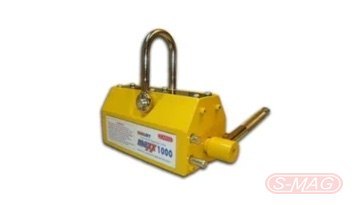
Permanent Magnetic Lifter
Hand lever lifting magnets from 100 kg to 6,000 kg
The price of a set of chains or slings is easy to see. Most of the cost of lifting with them is harder to see. It is spread across the shift, in crane time, labour, wear and repairs. A permanent magnetic lifter reduces many of these costs.
A crane does useful work only while it is moving a load. With chains and slings, the crane waits while the rigging is fitted, checked and removed. On a busy bay, one slow lift holds up the next job in the queue.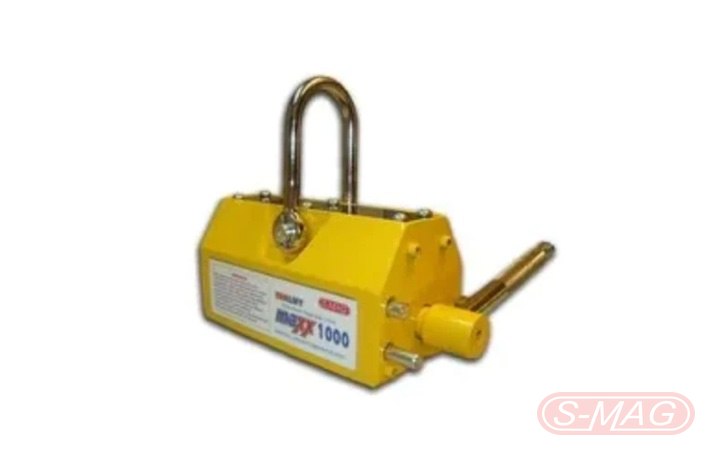
A magnetic lifter stays on the hook. It is set on the load and switched on with one turn of the handle. The crane spends more of each hour lifting.
A sling lift on a large plate often needs a second person to fit the slings and guide the load. That person is tied to the crane for every lift.
With a magnetic lifter, one operator can attach, lift and release the load. The second person can do other work.
Chains are heavy. Dragging them to the load, lifting them over plate edges and pulling slings out from under a load is hard physical work. By the end of a shift, the crew is slower. Tired people also make more mistakes.
A lifter needs one hand on the lever. The effort is small on every lift, so the operator stays fresh through the shift.
Slings fray and cut on sharp edges. Chains stretch and their links wear. All lifting gear has to be inspected, tagged and replaced when it is damaged. A shop that lifts plates of many sizes also needs many lengths and ratings, and each one has to be stored and tracked.
SMAG lifters use neodymium magnets and need no power and no maintenance. One lifter covers every flat or round load within its rating.
Chains dent edges and wire rope marks surfaces. On ground plate, machined parts or coated steel, a mark can mean rework or a rejected part. Padding the load takes more time on every lift.
The base of a magnetic lifter is flat and smooth. It leaves no mark on a finished surface.
A slipped sling or a trapped hand can injure a person. It also stops the bay. Work halts while the injured person is cared for, the area is made safe and the cause is found. A serious incident can close a site for days.
With a magnetic lifter, nobody reaches under the load to fit or release it. The handle locks in the on position, and there is no power supply to fail. Our guide on safer lifting covers this in more detail.
None of these costs shows on the invoice for the lifting gear. Together they add up over every shift. For a side by side look at the two methods, see magnetic lifters compared with chains and slings.
Santosh Magnetic Works makes the Maxx series of permanent magnetic lifters in twelve models, with flat load ratings up to 6,000 kg. Every lifter is tested to three times its safe working load before dispatch. See the range or contact us with the size and weight of the loads you lift.